Zardozi vs Gota Patti: Differences & How to Spot Real Work
Walk into any couture atelier in India and you will hear the work before you see it: the soft pull of thread through fabric stretched on a wooden frame, hour after hour. Long before a garment is cut or draped, much of its value is decided in the embroidery.
Two hand embroidery techniques have shaped celebratory Indian dress for centuries: zardozi and gota patti. Both shimmer with gold and silver, so they are often confused. Yet they come from different regions, use different materials and create completely different effects. This guide explains the difference between zardozi and gota patti, and how to recognise genuine hand embroidery when you see it.
In short: zardozi is raised metal-thread embroidery, stitched coil by coil with a hooked needle, and it looks rich, dense and three-dimensional. Gota patti is an appliqué technique, where shapes cut from woven metallic ribbon are hand-stitched onto the fabric, and it looks flat, luminous and light.
What is zardozi embroidery?
The word comes from Persian: zar means gold and dozi means embroidery. Zardozi (also spelled zardosi) reached its height in the Mughal courts, where it adorned royal robes, palace furnishings and ceremonial textiles. It later flourished in Lucknow under the Nawabs of Awadh. Today Lucknow zardozi carries a Geographical Indication (GI) tag, granted in 2013, which recognises Lucknow and its surrounding districts as the craft's home. Zardozi is also practised in centres such as Bareilly, Bhopal, Varanasi and Hyderabad.

Zardozi is worked in metal rather than ordinary thread. Historically the wires were pure gold and silver; today they are usually gold-, silver- or copper-plated. A karigar builds each motif from a vocabulary of materials:
- Dabka: a soft, springy coil of fine wire, cut into tiny lengths and threaded like beads
- Kora: a heavier form of dabka, for bolder raised lines
- Nakshi: a thicker, angular coil whose facets catch the light and glitter
- Salma: a very fine, soft spiral of wire used for delicate detail
- Kasab: flattened metal wire wound around a thread and laid along the surface
- Sitara: small metal spangles, the forerunner of the modern sequin
The fabric is stretched tight across a wooden frame, often called an adda, and the karigar works with a hooked needle known as an aari, which is why zardozi is also known as aari work. Pearls, beads and stones may be added for extra richness. The result is dense, raised and unmistakably regal: embroidery you can feel under your fingertips as much as see. A single intricate piece can take many days to complete.
What is gota patti work?
Gota patti belongs to Rajasthan. Jaipur is its main centre today, and the craft grew out of the royal and ceremonial dress of the region's courts. In Rajasthan it is also known as lappe ka kaam, and it is often simply called gota work.

Unlike zardozi, gota patti is not built up thread by thread. It is an appliqué technique. Gota is a narrow ribbon woven with metallic zari, and patti means leaf. Artisans cut the ribbon into leaves, petals, paisleys and geometric shapes, fold and arrange them on the fabric, then stitch each piece down by hand with fine, almost invisible stitches. The ribbon was once woven with real gold and silver; today it is more often made with metallised yarn, which keeps the shine while making the garment lighter and less prone to tarnish.
Where zardozi is sculptural, gota patti is luminous and smooth. It reflects light in broad, soft flashes, and because it sits so lightly on the fabric, it looks rich without feeling heavy.
Zardozi vs gota patti: the key differences

| Zardozi | Gota patti | |
|---|---|---|
| Origin | Persian roots; perfected in the Mughal courts and Nawabi Lucknow | The royal courts of Rajasthan |
| Technique | Metal wire and thread stitched with an aari needle | Zari ribbon cut, shaped and hand-stitched as appliqué |
| Materials | Dabka, kora, nakshi, salma, kasab, sitara, pearls and stones | Woven metallic ribbon (gota) |
| Texture | Raised, dense, three-dimensional | Flat, smooth, softly reflective |
| Weight | Heavier, with a structured feel | Light, with a fluid drape |
| Overall effect | Grand and opulent | Radiant and graceful |
Hand embroidery vs machine embroidery: how to tell the difference
As demand for embroidered Indian wear has grown, so have machine-made pieces sold as handwork. The difference matters: a hand-embroidered piece holds its beauty and value for decades. A few quiet tells:
- Turn it over. The reverse of hand embroidery shows knots, small irregularities and the path of each individual stitch. Machine embroidery usually leaves a neat, uniform layer of bobbin thread.
- Look for life in the pattern. Hand-worked motifs repeat, but never identically. Slight variations in spacing and scale are the signature of the human hand, not a flaw.
- Feel for dimension. Real zardozi has genuine depth, with coils and wires sitting proud of the fabric. Machine imitations tend to lie flat and feel uniform.
- Check how the gota is attached. In handmade gota patti, every shape is folded and stitched down by hand. Cheaper versions may be glued or fused onto the fabric instead.
- Notice the weight. Genuine metal work has a reassuring heft that printed or synthetic finishes cannot copy.
When zardozi and gota patti meet
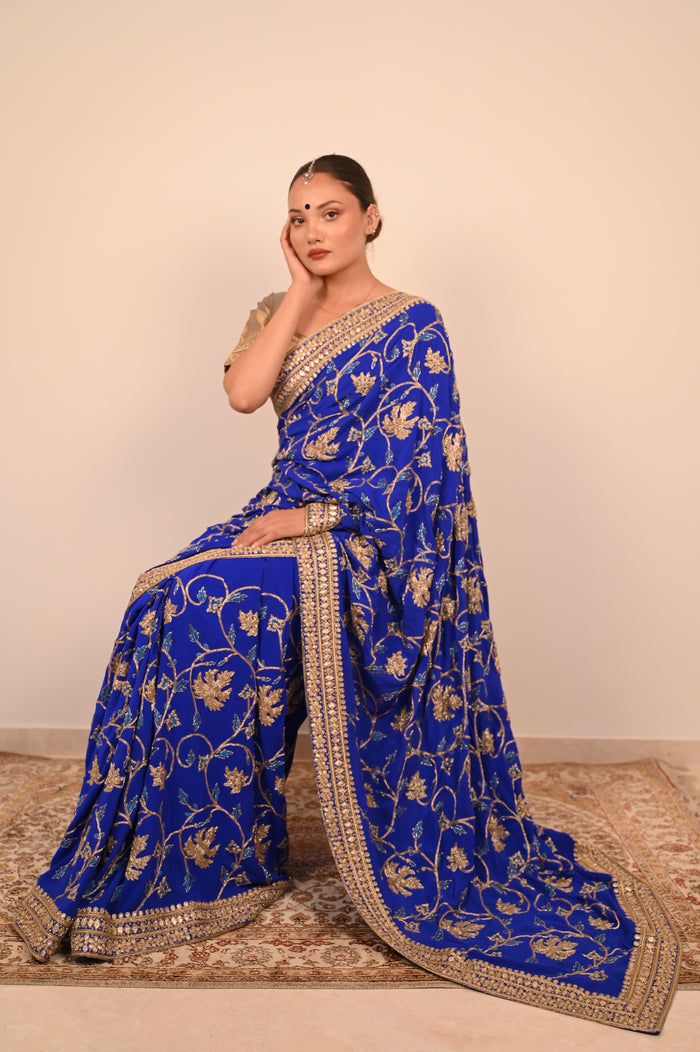
Some of the most beautiful sarees, lehengas and suits combine both techniques. Set side by side, the soft glow of gota patti and the sculpted richness of zardozi give a garment real depth: broad planes of light broken by raised, intricate detail.
Our Ivory Saree is one such piece. Worked on fluid georgette, it pairs gota patti with zardozi detailing, so it reads as luminous from across a room and intricate up close.

How to care for zardozi and gota patti
- Store pieces wrapped in soft muslin or cotton, never plastic, which traps moisture and can dull metal threads.
- Roll heavily embroidered sections rather than folding them sharply along the work.
- Keep perfume, deodorant and hairspray away from the embroidery. Apply them before dressing.
- Dry clean with a specialist only, and never iron directly over zardozi or gota; press from the reverse with a cloth in between.
Frequently asked questions
What is the difference between zardozi and gota patti?
Zardozi is raised embroidery made by stitching metal wires, coils and sequins onto fabric with a hooked needle. Gota patti is appliqué: shapes cut from woven metallic ribbon are stitched flat onto the fabric. Zardozi is heavier and three-dimensional; gota patti is lighter and smoother.
Is zardozi or gota patti more expensive?
Zardozi is generally more expensive. It is slower to make, as every coil and wire is stitched individually, and it uses more metal. Gota patti is quicker to execute, though fine hand-stitched gota work is still skilled and time-consuming.
Is gota patti made of real gold?
Historically, yes: gota ribbon was woven with real gold and silver. Today most gota is made with metallised yarn, which gives a similar shine at a fraction of the weight and does not tarnish as easily.
Is zardozi the same as zari?
Not quite. Zari is the metallic thread itself, which can be woven into fabric, as in a brocade, or used for embroidery. Zardozi is a specific embroidery technique that uses zari and other metal elements to build raised designs.
Which fabrics suit zardozi and gota patti?
Zardozi is traditionally worked on firm, rich fabrics such as silk, velvet and satin, which can support its weight. Gota patti's lightness also suits flowing fabrics such as georgette, chiffon and organza.
Hand-embroidered at Zardonia
At Zardonia, every piece begins with our karigars: artisans whose skill has been refined over generations. We work in hand embroidery because we believe a garment should carry the story of the hands that made it. Many of our pieces are made to order, so the work is done for you, not for a rack. From Dubai to India and beyond, each piece is made to be worn for years and treasured for longer.
Explore the craft across our sarees, lehengas, suits, kaftans and the new Festive Edit '26.